Two people can search the exact same keyword, at the same moment, in the same town — and see different businesses ranked in different spots. That used to be a rare edge case. After the May 2026 core update, it’s normal for local searches. Here’s what changed, and what to measure instead of the SERP you happen to see.
What changed in May 2026
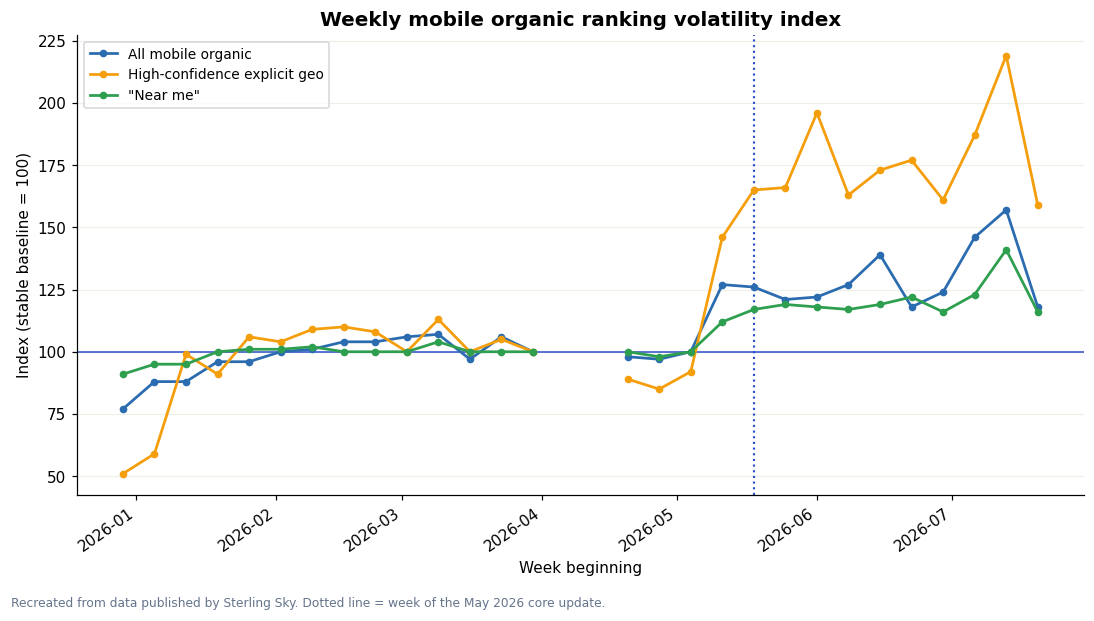
Starting the week of May 18, 2026 — the same week Google rolled out its May 2026 core update — organic local rankings became roughly 48.7% more volatile, according to analysis published by Sterling Sky. Across 8.16 million location-specific search results, 97% became more volatile than before. Three patterns stand out:
- Mobile organic results were hit hardest — far more than the local map pack, which moved but much less.
- Geomodifier keywords took the brunt. Searches that include a place name (e.g. “divorce lawyer Seattle” or “roof repair Denver”) now fluctuate far more than generic ones (“roof repair”).
- It happened for logged-out users with no click history — so this isn’t personalization (more on that below).
No, this isn’t just personalization
Google has personalized results for years — you tend to see websites you’ve clicked before. This is not that. The data above came from logged-out searches with no history, so the shuffling happens even for brand-new, anonymous users standing in the same location. The instability is in the SERP itself, not in anyone’s browsing history.
What a “shaken” ranking grid looks like
Here’s a concrete example from the data. Before the update, one Phoenix business had rankings that made sense: they ranked well organically everywhere except right inside the Phoenix city limits. Plot it on a map grid and you could read the logic. After the update, the same keyword put them at the top in one area, invisible in the neighborhood next door, then back near the top a few blocks later. It looks like someone shook the grid — and months later, in August 2026, it was still just as messy.
That doesn’t mean Google is throwing darts; there’s surely a complex system underneath. But from the outside, one thing is clear: there is no single position #1, #2, or #3 that everyone sees. You can absolutely rank first — for one search, one location, one moment. Someone across town might see you fifth, or not at all.
What this means if you run a local business
First, the good news: SEO isn’t dead. There are still clear winners and losers, and the businesses that dominate a market still show up more often than their competitors across the majority of searches. What changed is that no single screenshot tells the truth anymore. The number you see when you Google your own business is now one sample from a wide distribution — not “your ranking.”
So the more useful question isn’t “what position do I rank?” It’s “how often do I show up, and how often do I beat my competitors?” Answer that across hundreds of checks and the real winners become obvious: the businesses that appear over and over, consistently ahead — versus the ones that just occasionally get lucky.
Stop checking your rankings. Track these instead.
If you can’t trust the SERP you personally see, judge your SEO the way it should have been judged all along — by the business it produces:
- Lead volume over time. More calls and more form fills, month over month, is the real scoreboard. This is the number that pays you.
- Call tracking. Know which pages and keywords drive actual phone calls, so you can double down on what works.
- UTM tracking on your Google Business Profile. Tag your GBP links so you can see which searches send clicks and calls from your profile, not just where you “rank.”
Rankings still help you understand visibility. But calls and leads tell you whether that visibility is turning into sales — and that’s the part that matters.
Why single-scan rank trackers are now misleading
To actually know who’s winning a keyword, you need volume: hundreds or thousands of checks across a market, not one scan from your office chair. A single search is a snapshot; many searches reveal a pattern. Trying to understand a whole market from one ranking check is like trying to judge a year’s weather by glancing out the window once this morning — you need a lot more information.
So don’t panic when one ranking check looks terrible, and don’t throw a party when one looks amazing. Ask how much data is behind the report. It’s the same reason we measure our clients by calls and leads, not by a screenshot of page one.
Frequently asked questions
Why do my Google rankings look different on different devices or to different people?
Since the May 2026 core update, local search results are far more volatile. The same keyword can return different rankings to different people at the same time and place — even when logged out with no history. Your position is now a range, not a single fixed number.
Why is a single-keyword rank check no longer reliable?
Because there’s no longer one universal result for a keyword, and results fluctuate constantly. A single scan is a snapshot from one moment, one device, and one location — it can badly misrepresent what most people actually see. You need many scans to find the real pattern.
Is my SEO still working if my rankings keep jumping around?
Probably yes. Volatility in the SERP doesn’t mean your SEO failed — it means the results themselves are unstable. Judge your campaign by whether calls, form fills, and leads from Google are trending up over time, not by the ranking you personally see.
What changed in the May 2026 Google core update?
It rolled out the week of May 18, 2026. Analysis published by Sterling Sky, based on 8.16 million search results, found local mobile organic rankings became about 48.7% more volatile, with 97% of reports showing more fluctuation. Geomodifier keywords (searches that include a city or place name) were affected most.
How should a local business measure SEO now?
Look at patterns across many data points instead of one scan, and prioritize outcomes: calls, leads, and revenue. Use call tracking to see which pages drive calls, and UTM parameters on your Google Business Profile links to connect visibility to real business.
Does this mean rankings don’t matter anymore?
No. Rankings still matter as a diagnostic for visibility, and there are still clear winners. They were just never the goal — revenue is. Focus on getting more business from Google, not on any one #1 position.
The biggest lesson from the May core update: one search is a snapshot; hundreds of searches are a pattern — and calls and leads are the real scoreboard. Want to see what your Google visibility actually produces? Get a free audit, or read our running log of Google local SEO changes.